
Nature
The discovery of an almost complete skull in the Egyptian desert has led scientists to describe a 30-million-year-old species of an ancient apex predator.
Paleontologists from the Sallam Lab in Egypt have
discovered an unidentified species of the ancient carnivores Hyaenodonts. The leopard-shaped Bastetodon roamed the Earth 30 million years ago and probably sat at the top of the food chain with sharp teeth and strong jaws.
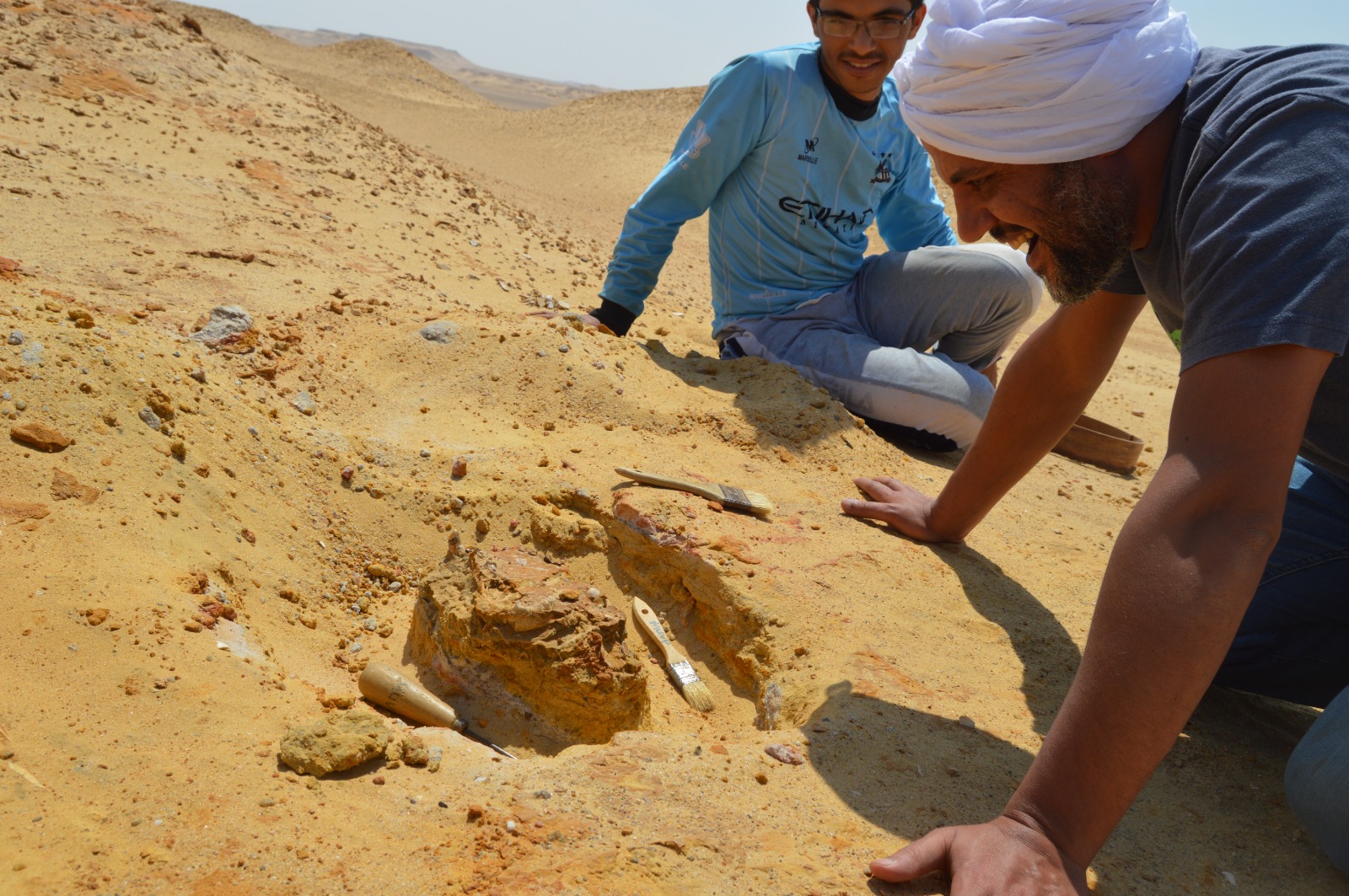
The fossil, described in the Journal of Vertebrate Paleontology1, was found at the end of an expedition in 2020 in the Fayum Depression, about 100 km south of Cairo and west of the Nile River. Just as the team was about to wrap up the excavation, Bilal Salem noticed some prominent teeth and called the rest of the team.
“It was a nearly complete skull of an ancient apex carnivore, a dream for any vertebrate paleontologist”, says lead author Shorouk Al-Ashqar, a doctoral student at the Mansoura University Vertebrate Paleontology Center (MUVP) and a research assistant at the American University in Cairo (AUC).
Computer tomography at Duke University and a 3D surface scanner at MUVP rendered an illustration of what the Bastetodon looked like. The team says the 27- kg creature preyed on elephants, and hyraxes in the lush forest of Fayum, which has now turned into a desert.
The discovery helps prehistorians better study the reason behind the hyaenodonts extinction 25 million years ago.
Hyaenodonts evolved long before modern-day carnivores such as cats, dogs, and hyenas. They hunted in African ecosystems after the extinction of the dinosaurs, Al- Ashqar explains.
The discovery allowed the group to reassess fossils that were unearthed 120 years ago and previously thought to have originated from subspecies of hyaenodonts that came from Europe – what the Sallam group later named Sekhmepthus.
Morphological and statistical analyses using phylogenetic analysis methods have shown, however, that Bastetodon and Sekhmepthus both belong to a group of hyaenodonts that lived in and originated from Africa. Almost 18 million years ago, some relatives of these hyaenodonts were among the largest mammalian meat-eaters to ever walk the planet.
However, changes in global climate and tectonic changes in Africa opened the continent to the relatives of modern cats, dogs, and hyenas. As environments and prey changed, the specialized, carnivorous hyaenodonts diminished in diversity, finally going extinct.
The team named the specimen after the cat-headed Egyptian goddess, Bastet, the symbol of protection, pleasure, and good health. Hesham Sallam, vertebrate paleontologist, and founder of MUVP, adds that Fayum is an area that reveals a significant window into about 15 million years of evolutionary history of mammals in Africa. This timespan captures the transition from the Eocene’s global warming to the Oligocene’s global cooling, and reveals how these climate shifts played a crucial role in shaping ecosystems of today.